


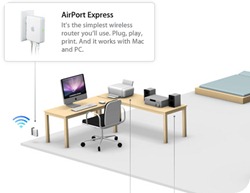
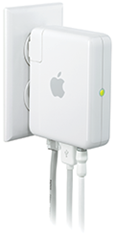
 The Apple Airport Express is not new by a long shot, 6 years in fact, but it does sport a nice feature making it worth mentioning anyway, a feature I failed to mention when commenting on Apple TV: They act as a remote output through what Apple has aptly named Airtunes. You can select Airports and Apple TVs around the house when playing songs from iTunes and have them play through one or more simultaneously. What is more, it has a Toslink connector buried inside the miniscule output jack for a purely digital connection to your sound system, should it support it. Actually, the Toslink connector is much preferred over the analog output due to excessive and quite audible hum from the built-in power supply.
 There are a few catches. You cannot kill a connection initiated by one computer from another, i.e. you cannot start your music from the computer in the office and then when you get to the kitchen, take a computer there and select another song. This can be a major hassle [to be very diplomatic] if you use more than a few computers. Also you are pretty much limited to playing music via iTunes. There are a few hacks out there allowing you to route sound from other applications to an Airport, such as Airfoil from Rogue Amoeba, but these tools are compromises. Particularly latency is a big issue, especially when watching video and routing the sound elsewhere. Applications competing for the Airtunes connection is another issue adding to the brew of annoyances. Having to manually kill a connection made by Airfoil to open one for iTunes is certainly not befitting my workflow.
Setting up an Airport is straight forward. With it comes a setup application that browses the network for Airports and lets you connect to whichever one you like and configure it. Should you have special needs in terms of authentication protocols or topologies it lets you handle that too, albeit considerably less elegantly.
The Apple Airport Express costs next to nothing so if you already use iTunes, this is a really cost efficient means to a distributed music system. Airtunes has some design flaws but works remarkably well considering.


 I may be pushing the icons above a bit on this one, since Linn has not yet disclosed anything specific on their new compact. Following in the footsteps of Naim and their Uniti, Linn has gone and committed a similar product. A complete unit, albeit sans the radio and the transport. Okay, so it isn’t a complete system. It does, however, appear that the Linn Majik DS-I has everything in the realm of in- and output. Even a phono input. All you need is a tuner for the BBC must-haves, a CD transport for the not-yet-ripped CDs and a pair of speakers that can receive the angel dust from the DS and sprinkle your abode with magic.
 British hi-fi deluxe company Bowers & Wilkins have spawned a first born of a new family of products – headphones. People have cried for years and begged for the mighty islanders to get on with it and build a pair. Now they have. Specs are sparse at the moment, as are all sorts of availability data. But the photos are portents of good things coming this way. Indeed.
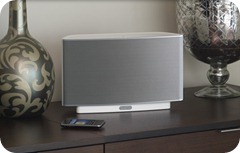 Sonos have ruled the streaming kingdom seemingly for eternities now but have been subjected to more and more frequent bashings for stubbornly sticking to less than standalone-friendly ZonePlayers. In others words: Why don’t they make a real standalone player for the kitchen (or wherever this makes sense)? Now they have… The ZonePlayer S5 is one such thing. A monolithic heat fan from appearance; a well spec’ed transistor radio beneath.
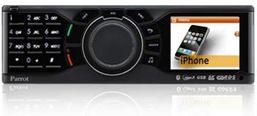 There are many more or less curious ways to get digital sound into your car many of which involve some sort of iPod connectivity. With this car sound system, Parrot have brewed themselves a concoction that raises itself above the rest, at least in terms of user experience.
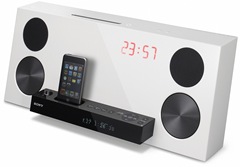 Now we are back to some bona fide digital news. Sony just announced a new system consisting of a media streaming apparatus called NAS-Z200iR. As to why Sony have chosen to use the term
 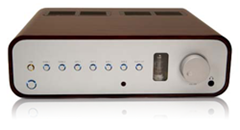 The rather unusual integrated amplifier,
 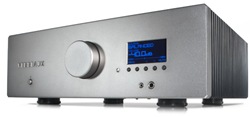 While claiming to be the most powerful integrated amplifier in the world seems a bit much given the specs, this certainly is an impressive piece of machinery. Not that amplifiers normally stream much except for the odd electron, this amp stands out thanks to an unusual approach to modularity allowing you to extend it with not only a RIAA module but also letting you add a 24bit/192KHz DAC with 5 inputs, including USB. In other words: It really does earn a place on this blog.
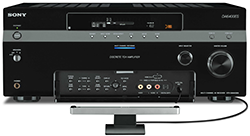 Sony have announced a new line of home theatre receivers creaming the competition with a top model 7.1 receiver showing some rather unusual features.
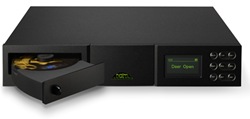 The NaimUniti is a 50W integrated FM/DAB receiver with built-in CD transport and internet connectivity. It accepts USB devices, controls an iPod, reads CD-R discs and streams music from the network, including internet radio stations.


 CD drive
 Wifi
Wifi Flac audio
 Digital IO
 Ogg-Vorbis
 uPnP support
 Video
Video